
Artistic Director Jen Lyons-Reid and Creative Producer Carl Kuddell were interviewed by Sophie Hope, Senior Lecturer, Department of Film, Media and Cultural Studies, School of Arts, Birkbeck College, University of London, and Henry Mulhall, research assistant, Birkbeck College.
They run a fascinating game project, called Cards On The Table, exploring the how games can be used to facilitate difficult conversations.
Here is a link to the full interview on their blog.
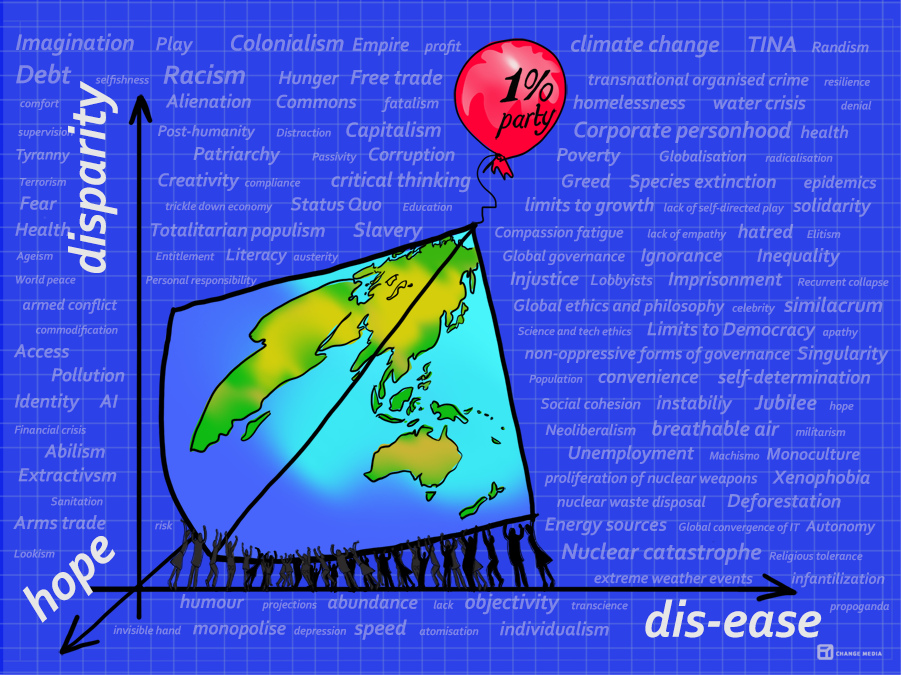
Artwork Change Media
And here is interview:
Hi Jen and Carl, thank you so much for taking the time to talk to us. Could you start off by telling us what the game was initially designed for?
Jen
We're constantly looking for any tool that can generate challenging conversations with and by communities, for us, the game is an artwork. Using the cards when gaming is just another storytelling device. We started with the concept of how to unpack the complexity of our interconnectedness, given that we live in a cultural frame where an ignorant, privileged belief system is idolised. We wanted to look at the thinking behind the thinking. The absurd part is that we decided to use a pack of 50 cards arranged in a grid, to move away from binaries of good and evil.
We wanted to sit with people, with the various communities we worked with, to actually look at ourselves and the ignorance that we hold. A simple card game version of the work is a ‘Tarot’ - self-reflection, not surprising - but people really struggle to sit with each other and look at their ignorance. With various audiences, the cards have been fantastic, but they split people. We've had a room full of hundreds of people playing ‘My Team is Better Than Yours’. People use the cards to assess their organisation's privileges and how they can change. We go back and use them every time we come up with an absurd idea; the 50 characters come out and harass us!
Sophie and Henry: Can you tell us more about the contexts you’ve played in?
Carl
Initially, we used it as a tool for community arts and cultural development practitioners or organisations to develop critical awareness. It was a toolkit to help gain a sense of radical critical literacy and to have difficult conversations about the colonial practice we’re all always engaged in. We are agents of empire, even if we try not to be. We’re often paid to come into difficult circumstances and work with marginalised or excluded communities.
In the first 10 years of our practice, we often came across this sort of Wild West cowboy politics where people literally come to town, and get paid a lot of money for a two-day workshop, and no one shows up or can access it because the barriers are way too high. It really only benefits the already privileged.
We created card role-playing games to reveal our subconscious privileges and tactics. Some people really loved the idea of a sarcastic, ironic Tarot kit, you know, the idea of playing in a fake Jungian worldview, but we didn't want to have the essentialism of inbuilt archetypes. We saw so many repeat behaviours in ourselves and in others, and an inability to speak about privilege - privilege is like Fight Club, the first rule of privilege is don't talk about privilege. Now, 10 years on, it has become the first rule, we are meant to talk about our privilege: My name is Carl, and I’m a white, male, sis, privileged person from blah, blah, blah. That doesn't get to the heart of the matter, it becomes competitive and performative. We wanted something where we could pierce through the performative aspects of those professional engagements and disarm people with playfulness and silliness by using cartoon characters, with a Tarot-adjacent format, where people can just open up through gameplay to ask, what are the power relationships and how are they being negotiated?
Sophie and Henry: Can you tell us a bit about how the game is played?
Carl
Players randomly pick three cards from the deck of 50, that is your past, present, and future to reflect on your practice. Or sometimes we have people pick a hand of five from the deck and work with a bunch of people in a group to pick their best project that would win the colonial grand prize.
By asking people to take part in a Brechtian gameplay, by using alienation tactics and exaggeration, people can be mean and vile in a supposedly safe space – but safe spaces don't exist. The cards and gameplay help us frame things, it pushes players into a methodology of notice/disrupt/reframe. It’s an iterative, circular motion where we get people to notice their behaviour, to disrupt it, and then collaboratively reframe it, ideally with a sense of solidarity. But that's where it also got stuck, noticing is great, in the reflective sense. Disruption is beautiful when you're disrupting others. And reframing is beautiful when you can do it performatively. We live in a culture of fear, negotiating how we share and risk taking is not so performative.
Sophie and Henry: It sounds like people are quite challenged by the format.
Jen
The difficulty is that when you're sitting in a group, it is so much easier to point a finger at somebody else. Also, those people who got the concept really got it and deeply engaged. And then a lot of people who didn't, not necessarily that they didn't understand the structures, but they didn't understand it on a meta level, took it literal or found it really confronting. People would say, they couldn't believe this other person was so racist, or they couldn't believe that they were so ableist. We've worked with groups that suddenly fell apart because people misunderstood the gameplay. The organizations found the sessions very revealing, helpful, but we changed that game, we want our work to punch up, not down.
Carl
There’s a voluntary requirement for gameplay, you cannot play this kind of game with someone who has been cajoled to be part of it, because they tick the box of inclusion or whatever.
Sophie and Henry: Tell us more about the kind of people and groups you collaborated with through the development of the cards.
Jen
We worked with a long-time collaborator, Clyde Rigney Jnr, he's a leader of the Ngarrindjeri Nation. We sat with him, and he went through the 50 cards, and we created several artworks together using the cards. He'd be hysterical and add his experiences working with bureaucrats and the colonial wall that he would be confronted with. He knew each character. We've created half a dozen projects with him, just based on using the cards.
It's the same working with radical artists in the disability space. Kath Duncan used the cards to create ‘The Oppression Olympics’. She has amputations and is in a chair, she's a fucking brilliant artist. She worked with Veronica Pardo, the then CEO of Arts Access Victoria. They got up on stage, and they got an audience of about 200 people to vote who was more privileged. It didn’t matter how much Kath put forward, that she was more privileged than the other white, able-bodied woman, the audience could not see past her being in a wheelchair.
Our experience has been people who do understand radical thinking around critical literacy, love the cards, and find it a really powerful tool.
Sophie and Henry: How has working with others changed your view of the game?
Jen
We've put aside the “My project is better than yours”, and turned it into “my team is better than yours”. We created these nasty missions, teams get to use our 50 characters - you get three of them in your team - and you compete against other teams to prove that they would be the best for the job. It created the same awareness, but it took away the tension of trying to create art projects. People felt uncomfortable that they were bringing forward all of this thinking based on supremacy.
Carl
For me, one of the aims of the cards was to create a safe distancing tool, something people could project onto very easily.
People say, oh yeah, this card, ‘The Bystander’, that’s that guy at work, I know that person so well. Then we would do a few rounds on trying to establish some sort of group rules and reciprocity and mutual understanding. We don’t want to blame and point the finger.
We found that when we actually prefabricated 150 missions with a couple of game rules, people would allow it in, like a Trojan horse. The barrier to entry, to self-embarrassment, was lower. We got invited to present it at the Adelaide Festival for Ideas in 2018. There were about 100 people or so on big round tables playtesting. That was quite an interesting mixed group. So people had fun with that.
Jen
The original idea was that it was an art experiment. We played with it, and it's done all sorts of amazing stuff, but we don’t see ourselves as teachers, we have to step back to let groups work out what’s the value for them. We could peddle the experiences we’ve had but prefer to make radical art and use the cards as a storytelling device.
Sophie and Henry: Are you still developing new projects with the cards?
Jen
They keep giving us hope, the current work we're playing on is called ‘NearNow – it’s coming straight for us!’ Our plan is to take about 10 investigative artists and break into the metaverse. The idea is the metaverse will be inhabited by the 50 characters who are going to just constantly try and co-opt us into being complicit and continue our denial of climate catastrophe, and you know, all of the other injustices we’re constantly bombarded with.
Carl
I've wanted to have a conversation about complicity for years that still goes right back to my more hands-on activist days in the Western German anarchist, autonomous scene and radical men's movement as a pro-feminist. We played a lot with antagonistic principles and a sense of agonies and exaggerations, trying to make the mundane oppressions suddenly special by shining a light on it.
The intersections of power and privilege are something that we need to address, not in the sense of what we are entitled to, but how we can fight them. How do we unite those things? It comes from a very old-school approach to political activism, libertarian anarchist organising etc. When we showed it to the critical community art sector, we became quite the darlings to start with, because people saw we had tools that people could easily adopt, and they'd be useful. We just wanted people to have honest and radical conversations that led to actions. Without actions, the reframing is worthless, it's just a performance.
We've wanted to have a conversation on restructuring power, not power as something evil as it’s often framed in progressive scenes, but as something unavoidable. Power and privilege behaviour types are unavoidable givens. Over the years, we’ve reframed this. Instead of talking about safe spaces like quasi-therapeutic containers, we say you're entering a contested space at your own risk. We are now here to renegotiate the rules of engagement. With that, we need to look at the baggage that we bring, it's unavoidable and that is not a pretty business. But the game is not intended as a blame-shifting toolkit. It is for the recognition of radical playfulness. There's nothing more powerful than watching children negotiate gameplay, we wanted to tap into that space.
Jen
It’s not to assign blame but to ask, what else can we imagine? At a very basic level, we all want control, any negotiation is about power and privilege. That isn’t gameplay, that's life. If we imagine that life is a game, and therefore has a set of rules, which are hidden mostly from us, it’s extraordinary when we discover those rules. At any given moment, we can change those rules, we can renegotiate them. Tomorrow, we could all wake up and say fuck, this game isn't working, let's do it differently.
Sophie and Henry: You mentioned the game as a storytelling device. I wonder about the idea of story theft and the ethics of initiating a game. Do you extract or harvest those stories?
Jen
When we facilitate card games or run video and art workshops, we advise the groups that any collaborative storytelling belongs to the group, so be ready to negotiate, or don’t share. When people develop work from the cards, we ask they acknowledge the cards, and us by extension.
We have shifted our community art practice over the years from film-making to creative provocations. We coined the term ‘Story Theft’ in 2007, when digital-storytelling became a thing. We explored the concept in a thought piece commissioned by the Australia Council in 2011, called ‘Get Off My Back’, a manifesto to look at ways to address colonial practice and story extraction in digital storytelling.
Now we work with communities who want to radically explore, they identify issues, we create artistic provocations, using the cards, which they creatively respond to. So when we use the cards, we have already developed a project with the artists and their communities, so it’s an artistic collaboration and we negotiate shared copyrights, acknowledging the cards previous existence. We have a Kungun Yunnan Nukkan Agreement with the Ngarrindjeri nation, that recognises cultural and moral IP.
We're not really story gatherers. I love that all of us have stories but I'm not interested in collating or comparing or being responsible for bringing forward other people's stories. We regularly review our practice and ask ourselves what we've actually been doing. We imagine that we're doing one thing, for instance, when we were running video workshops, we would support communities who had never used video to make their own stories, but on reflection, we were actually setting up temporary autonomous zones.
We found that especially in the indigenous or refugee spaces, there was always somebody gleaning, syphoning up the stories, from the big TV networks to the local councils. But I think for me, the magic, using whatever devices we use, is just to sit with people while they have that experience of creating a temporary autonomous zone, that space in which, you know, the game is revealed.
Carl
People needed to have awareness of a problem. Filmmaking meant we were making some kind of fame-adjacent products for people that already had solutions on the table. So we came in as problem brokers. That’s not such a hot ticket now. If people want to have critical literacy and cultural awareness training, they want to have it done by a fluffy, non-threatening black person ideally, and not by some scrawny, annoying white blowflies who get on your nerves and are arrogant and difficult to deal with. So, I didn't really want to hear the people's stories coming out of it. But what I loved was when the lights turned on, when that person became aware that everything is negotiable.
Most of us, through our upbringing and cultural conditioning, learn that things aren't really negotiable. That there are always power relationships and the caste system that stops us - glass ceilings, etc., exclusion zones. So we wanted to create a space where this could be changed as part of a workshop model and then gamified through a rule-based card system. A few years later, we realised that it's not so much about everything being negotiable, but that everything is being negotiated. The question is, how much are you able to participate? Then we enter much more into the underbelly of privilege as an exclusion zone where we can hide our ignorance in power, not so much as a power to oppress, but the power to access, power as a tool that makes stuff happen.
We're at a tricky crossroads. That's why your interview request came at an interesting time - we have used this game now very much for our own benefit. Jen got a two-year National Fellowship, ‘Creating Together, what can possibly go wrong?’, out of the game to interrogate harm and value in community art, which was very appreciated. So we redeveloped the card game over and over. Downstairs in the studios, we have big vaults of the 50 characters and the different iterations of what the game can do. So we are wondering if we pursue game facilitation and produce all the games or stick with absurd art.
Sophie and Henry: Did any other games influence you? What do you think the value of gamifying is?
Jen
We have invented dozens of games by now, but we don't go any further with them. You know, we get bored, we go down, and we spend a day reworking the grid. We just laugh hysterically. But, you know, we're still trapped in a grid we've made. Really, it comes back to this idea that life is a game and how to create temporary autonomous zones. So whatever tool to work with a group of people, people we've never met before, and to be able to say, hey, we could do this completely differently.
I got totally into gaming and game mechanics and bought a shitload of games. All sorts of children's games, you name it, any card game. We played them through and tried to unpack them and work out the mechanics, trying to work out all the hidden rules that we were playing with.
Two games came up when you were talking. One is ‘The Game’, where you go and tell your friends that they're playing the game, but the minute you remember you're playing the game, everyone loses - a forgetting/remembering game. Infuriating if winning is the only rule we live by. The other one is around looking at non-hierarchical organising, it’s a systems game. You get one person to facilitate, anyone can, and you get everyone to stand up. And then each person chooses two people to be equidistance between. The game is just that, you must always be between those two people. And the room self-organises and just clicks, you know, very quickly, self-organises, but not because you have forced anyone else to participate. It's because you insert yourself in between two people, you have influence, not force, and, you know, a very anarchic way of understanding organising.
Carl
My little, you know, high-achiever, market-profiteer wants to sell them and is slightly disappointed that it's not competitive with Cards Against Humanity. It's just not as much fun. But it was painful when we were just getting ready for our first launch, I think in 2014, that game went gangbusters. Anyone we talked about our game was just like, oh Cards Against Humanity. And we're like, nooo, this is horrible.
Sophie and Henry: How is or was the game funded?
Jen
After the first two iterations, which were funded by the Australia Council, we worked with Christy Dena, a cross-media storyteller who’s done international game design circuits. She worked with us to look at how we could peddle our game. One of her approaches was to work out why and how other practitioners would use our game. She had us review the circular model we devised to explore the creative process; collaboration, ideation, development, production, distribution, and at each point, think about how the game is useful. That was really fantastic, but we haven't pursued it. I think if we had, we would have needed to make it a reform tool, and the radical element that we want to play with would be gone.
Carl
We sold a bunch of units so that the print runs paid for themselves, we didn't have to spend money on it. That indicated there might be a market for it. But we don't like selling stuff, we prefer to get public funding, and then make stuff available for free, so that participants don't have to pay. If it becomes market-driven, the anarchic fun is stripped out of it, and everything gets pushed towards productivity.
Having said that, we all apply for funding in a competitive sense and feel great when we win, calling it ‘healthy competition’. When we actually wonder what's healthy about it, this is an assumption that we're not allowed to criticise, if we want to keep getting funding.
Jen
The alienation techniques of capitalism far outstrip any techniques that we're coming up with. We are all reward-based, capitalism has pushed us all into a space of commodified human exchange. Most of our exchanges are now transactional so it's not surprising that the children doing the lemonade stand are rewarded, and the children having a bit of a fight to work out how to negotiate are frowned upon.
We were privileged in that we had the money coming in to make the artwork so we had the choice not to pursue the game in that way.
Carl
Strategically, we’re trying to find new modalities of conversation away from success metrics and performance indicators, getting away from the whole productivity framework is important for us. Even to try for a 10% threshold of degrowth or to find new ways of power-sharing or collaboration, we will need to change the metrics on how we assess our work.
Sophie and Henry: Are you still developing games in new directions?
Carl
We did a work in collaboration with 100 community participants and a bunch of artists called ‘The Colony’ and redeveloped the cards into cartoon cards called 10 Easy Steps to Supremacy. We tried to simplify the grid after some critique from workshops, especially from the disability sector. 50 cards are just a lot to take in, to learn the literacy to play the game successfully, if you don’t just randomly pull cards.
In 2019, we boiled it down to 10 easy steps to address everyday supremacy thinking. The idea was it's all hiding in everyday, normalised behaviours and privileged assumptions. It really came down to a conversation about the social-Darwinistic framing of competition as something good, that it's natural and inherently good for us.
We simplified it by using gangs. There are 10 gangs in our game, each depicts an easy step to supremacy thinking, from pacifying to obeying to manipulating, controlling etc.
Jen
We've based ‘The Colony – Dare to Stop Us’ work around a walk through an IKEA store. That whole concept of being pushed through a maze that infantilizes people. It's a technique that IKEA revolutionised and every other store tries to mimic, how to infantilize people to buy more shit. The concept was the audience could become recruitment officers for The Colony or create artworks for the Resistance. Then a couple of years ago in 2020, we used the cards to create a work called ‘This Breath is not Mine to Keep’. We melded our 10 gangs with the Kübler-Ross concept of grieving and added a few extra bits, liberation and revolution, to the grief states. The idea was people would go on a journey of grief around climate catastrophe around the shitstorm that we, the global privileged, are creating. If we don't actually have those conversations, if we can't acknowledge what state we're in, how do we come together? There were online provocations, 5 physical exhibitions, hundreds of artworks created and the pandemic.
Carl
The same thing happened in reverse, people were quite happy to talk about the mess, and that they miss the natural environment, like how the blue Goldfinch has gone. It is bloody sad. Yeah, it's a real thing, but for us, it was a Trojan horse to use the grief conversation to talk about systemic violence. But the individualist framing really prohibits that. During the pandemic, our ability to engage with audiences was severely limited and mostly went online which got quite boring.
Sophie and Henry: We’re often faced with the difficulty of people not wanting to have those hard conversations, or not wanting to really engage with processes of self-critique. How have you found that when using your cards?
Carl
Silos come up for me a lot, we thought that critical literacy would be a desirable activity for people to break down silos. We saw it coming when we had massive public arguments, in our function on boards, or national sector reviews and committees, we’d argue quite heavily against co-opting the notion of self-organised safe spaces from the Māori health system in New Zealand/ Aotearoa into an Australian context or in a global context. Creating safe spaces from top down will shut down critical debate and critical literacy and the ability or desire to engage critically and radically. We saw that coming as a wave and this will crash over us.
Jen
Games are perceived as being childish, but I think the best way we could move forwards is if we take ourselves far less seriously. Props are a brilliant way to work with a lot of communities, props and laughter. People open up and feel relaxed, so we can communicate more easily. We bring in props and humour to try and crack open a shared space, in a very small time. We all only have a really small time on this planet. One of the biggest problems is that we just don’t have enough time. Oh, I just remembered.


Sed purus sem, scelerisque ac rhoncus eget, porttitor nec odio. Lorem ipsum dolor sit amet.